
You’re probably reading this on your second screen, while ChatGPT writes your assignment and some YouTube guy explains “10 AI tools that will make you rich in 2026.”
Meanwhile, the thought in the back of your head is: Okay but… will this thing also take my future job?
This site exists in that exact tension: AI tools, AI news, tutorials, and that annoying little question of “what does this do to my actual life and career” if you’re 18–25 and just trying to pick a path that doesn’t evaporate by the time you graduate in India or anywhere else.
Now we have new studies telling us which jobs are most exposed to AI and they’re not just factory workers or random US jobs in headlines. They’re exactly the kind of “smart” careers students have been pushed into for a decade: programming, finance, customer support, junior data work.
This article is not here to comfort you. It’s here to show you which jobs are actually at risk in 2026, how that risk really works behind the scenes, and what you can do so you don’t graduate into a role where 70% of the work is already done by a bot.
THE THING NOBODY ACTUALLY SAYS OUT LOUD
Here’s the awkward truth: AI isn’t coming for “low-skill” jobs first. It’s coming for the boring, repetitive parts of white-collar work that your parents proudly tell relatives you’re “preparing for.”
Computer programmers, customer service reps, data entry clerks, junior analysts these are showing up at the top of multiple recent risk lists. One study found that around 74.5% of typical programmer tasks can already be automated by existing AI tools. Another shows customer support and data entry roles above 80–90% task automation exposure.
Nobody says this out loud in college seminars because the entire system still runs on the old script:
- Do engineering, BCA, BBA, or a “computer” degree.
- Get a campus placement.
- Sit in front of a screen and do structured work.
The problem is: structured work is exactly the kind AI eats for breakfast.
You don’t need to be an economist to see it. Look at your own life:
- Chatbots now handle basic customer queries on Swiggy, Zomato, bank apps, and airline sites.
- Auto-generated emails, captions, and content drafts are everywhere in marketing teams.
- Even coding students are using AI tools as the first attempt before Googling.
The scary part isn’t that AI will “take all jobs.” The scary part is more specific: AI is quietly killing the entry-level in many fields.
The step where you used to join as a fresher, do grunt work, learn on the job, and grow? That’s exactly the step companies are replacing with tools. For example, Anthropic’s analysis shows AI can now handle most basic coding and a huge chunk of customer service and data entry tasks, while hiring for 22–25-year-olds in high-exposure roles has already dropped around 14% since the launch of ChatGPT.
So, when people say “AI will create new jobs,” they’re not lying World Economic Forum and others estimate AI could create tens of millions of roles globally in coming years. But they skip the fine print:
- Those new roles need skills you don’t get from just passing exams.
- Many are mid-to-high skill, not generic fresher positions.
- Competition is global, not just your batch or your city.
Meanwhile, repetitive office work that looks “safe” because it doesn’t involve physical labor? That’s under heavy fire.
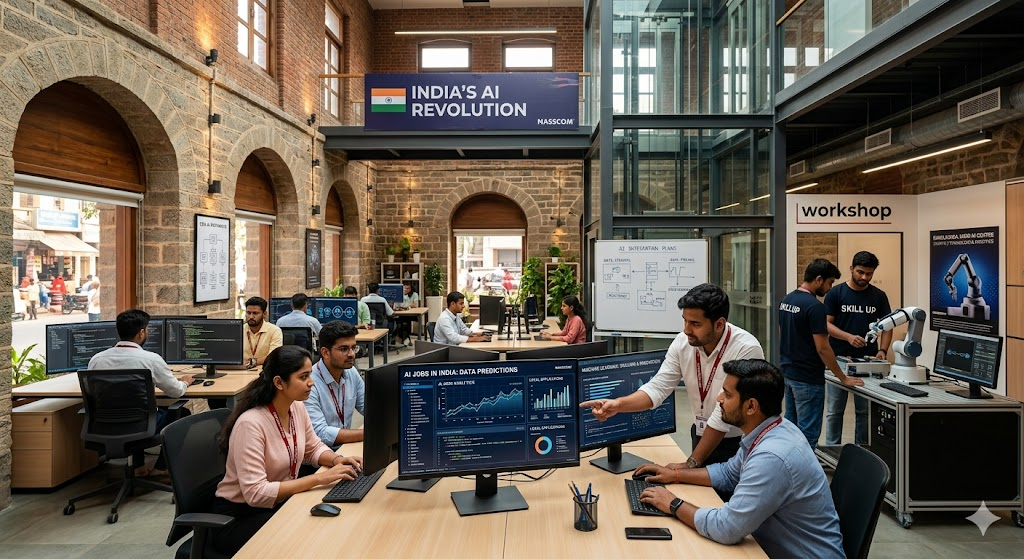
If you’re in India, this hits extra hard. The whole “services powerhouse” story BPO, IT services, back-office operations leans heavily on exactly the categories AI can automate: customer support, data entry, process monitoring, repetitive reporting.
The part nobody says in career counseling: you can’t just pick a field anymore. You have to pick the tasks inside that field that are hard to automate. And yes, that’s as exhausting as it sounds.
HOW THIS ACTUALLY WORKS THE REAL MECHANICS
Let’s strip away the drama and see how AI risk actually gets calculated. Studies don’t say “this entire job disappears by 2026.” They look at tasks inside a job and measure what percentage of those tasks current AI systems can already do.
Take a typical customer support agent. Their day is mostly:
- Looking up info in a knowledge base.
- Answering common questions.
- Logging cases.
- Escalating rare problems.
AI tools can already automate 80–85% of that routine flow when the questions are standard and the company has decent data. Humans stay in the loop only for edge cases, angry customers, or complex situations that need empathy and judgment. In other words, fewer humans, doing more intense work.
Same pattern with data entry and processing roles. OCR (optical character recognition) plus AI can now read documents, extract fields, clean messy formats, and push data into systems with minimal human checks. One industry breakdown puts data entry at over 90% automation exposure. That doesn’t mean every operator is fired instantly, but it does mean companies can handle the same workload with far fewer people.
Here’s the niche corner almost no generic “future of work” article talks about:
It’s not just which job title you choose, it’s what tasks dominate your first three years in that job.
Some examples of high-risk task patterns in 2026:
- Rewriting, summarising, or formatting text all day (routine content production).
- Copy-pasting or validating data in spreadsheets or software.
- Following a fixed script with customers over chat or email.
- Running the same type of report and writing the same style of insight every week.
- Writing simple, pattern-heavy code for well-defined problems.
On the flip side, where does AI struggle more?
- Work that needs real-time, high-stakes physical presence (electricians, nurses on the floor, field technicians).
- Roles mixing domain judgment, stakeholder management, and unstructured problem-solving (product managers, good teachers, some kinds of consultants).
- Jobs where relationships, trust, and context matter more than raw information (therapy, certain sales roles, leadership).
So when studies talk about “AI exposure,” they’re basically saying:
“If we break your job into 100 small tasks, how many of those can a tool realistically do now or very soon?”
A career-risk view for 2026 looks something like this:
- High exposure: computer programmers (esp. juniors), customer support, data entry, routine content writers, junior analysts.
- Medium exposure: financial analysts, office administrators, legal researchers, marketing assistants.
- Lower (for now): jobs heavy on physical work, social care, on-the-ground operations.
One more thing: AI adoption is ramping up faster than vibe-based Twitter takes. OECD data shows AI use by individuals and firms has jumped sharply from 2023 to 2025, with more than a third of citizens in member countries using generative AI tools by 2025. That’s not “future,” that’s your current timeline.
The real mechanic is brutal but simple: the more predictable and screen-based your work is, the more your future boss will ask, “Can a tool just do this?”
COMPARISON WHAT’S ACTUALLY DIFFERENT BETWEEN YOUR OPTIONS
Here’s a quick reality-check table for different job types if you’re planning your path in 2026.
| Option | What it actually does | Who it’s for | The catch |
| High-automation desk roles | Repetitive digital tasks: data entry, Tier 1 support, routine content, basic coding | Students wanting quick placement and predictable tasks | AI already automates 60–90% of these tasks; entry-level hiring is shrinking |
| Tech-adjacent, human-heavy roles | Mix of tools + people: product ops, support escalation, trainers, coordinators | Students okay with talking to people, not just screens | Needs soft skills and context skills; harder to fake with just certificates |
| Deep-tech / AI-building roles | Design, build, and integrate AI systems, data pipelines, decision tools | Students ready for serious math, coding, and long learning | High competition; you must stay updated constantly and can’t coast |
| Field & operational roles | On-ground work: installation, logistics, healthcare support, maintenance | Those who like physical, real-world problem-solving | Less “glamorous,” but currently harder to automate fully |
If you want an actual recommendation: aim for roles where AI is a tool, not your replacement. That usually means tech-adjacent or deep-tech paths where you speak both “human” and “system,” or operational roles where screens support you rather than replace you. Staying stuck in purely repetitive desk work in 2026 is like willingly choosing to stand on railway tracks and hoping the train is delayed.
WHAT ACTUALLY HAPPENS WHEN YOU TRY THIS
Let’s talk about what it feels like from the inside when you actually work in a role AI can hit.
Imagine you join as a junior content assistant at a small agency in India. Week one, your manager says, “We use AI to generate first drafts, you just refine them.” Sounds great. Less work, right? For a few weeks, it does feel that way. The tool spits out passable copy, you tweak brand tone, fix weird lines, add local references, and you feel smart.
Then you notice something subtle. The tool keeps getting better. The prompts become more detailed. Templates get refined. Your “editing” slowly turns into approving 70% of what the tool writes and fixing 30%. At review time, the company asks: “If the AI can do most of this and you’re just polishing, why are we hiring multiple juniors?”
Same story if you land in a customer support chat role. You start with manual replies. A month later, the company integrates AI suggestions into your support dashboard. The bot drafts an answer; you just click approve or adjust it. Over time, managers track which questions can go fully bot-first. The clean, predictable, repeatable stuff gets moved to “AI only” queues. You handle the messy cases, which are fewer but more stressful. Fewer humans can now do the “hard” 20% of tickets.
The part that surprised a lot of people in recent studies is this: unemployment hasn’t exploded yet in the most AI-exposed jobs, but hiring for freshers into those roles has already dropped. In other words, senior people often keep their jobs, but the ladder underneath them is being slowly removed.
Another pattern most glossy “future of work” pieces skip:
When AI enters a team, the boring tasks vanish first but so do many of the easy learning opportunities. In older setups, you learnt by doing grunt work: writing basic code, drafting simple reports, answering simple calls. Now those starter tasks get automated, and you’re expected to jump straight into “add value” mode.
Students who only know tools at a surface level struggle here. The ones who do better usually:
- Understand why the tool works the way it does, not just which button to click.
- See patterns across tasks and suggest improvements, not just follow SOPs.
- Have enough domain knowledge to question bad AI outputs instead of blindly trusting them.
When you try to build a career in 2026 without thinking about AI exposure, you get whiplash. The role you studied for exists on paper, but the day-to-day reality is:
- More task automation.
- Higher expectations from fewer staff.
- Less patience for slow learners.
It’s not hopeless. People who lean into AI using it to speed up their work while building skills the tool can’t easily copy tend to move up faster. But the default route of “degree → fresher job → grind” is quietly getting patched out of the system.
THE ADVICE EVERYONE GIVES VS WHAT ACTUALLY WORKS
Let’s drag some popular advice into the light.
1. “Just learn coding, that’s future-proof.”
Reality: basic coding is one of the most automatable parts of tech. AI tools can already handle boilerplate, simple functions, bug fixes, and even full small apps if the requirements are clear. This doesn’t kill software as a career, but it absolutely kills the idea that writing simple code equals long-term safety.
What works instead is moving up the stack: understanding system design, product logic, user needs, and how to integrate multiple tools. If you write code, make sure you’re the person who owns why that code exists, not just how to type it.
2. “Follow your passion, money will follow.”
This sounds nice on Instagram, but passion doesn’t protect you from automation if your “passion” is something like writing generic blog posts or doing aesthetic but repetitive design work. AI can already ship thousands of “passionate” pieces per second with zero burnout.
A better version: follow your curiosity, but stress-test it against reality. Ask:
- Does this field have tasks that are hard to automate?
- Can I combine this interest with tech or human skills AI is bad at?
Passion plus strategy beats passion plus vibes.
3. “AI will create more jobs than it destroys, so relax.”
Yes, many reports predict AI will create millions of roles globally by 2025–2030. But those roles are not evenly distributed or instantly accessible. They tend to cluster around advanced tech, data, and high-skill services, and they demand constant learning.
What works is to treat those new roles as targets, not guarantees. Instead of assuming “new jobs will appear,” you identify two or three emerging roles that look interesting like AI product specialist, data translator, AI-enabled teacher and start building towards them now through projects, internships, or freelance gigs.
4. “Soft skills are the future, just work on communication.”
Communication matters, yes. But vague “good communication skills” is not a career plan. There are plenty of well-spoken people who still end up in highly automatable roles answering scripted chats.
The useful version is: combine real domain skill with specific human abilities AI still struggles with negotiation, conflict handling, strategic thinking, mentoring. Soft skills only help when they sit on top of something concrete. A personable data analyst who can explain insights to non-technical stakeholders is harder to replace than a “good communicator” with no hard skill underneath.
The pattern here: generic advice is either incomplete or 5 years outdated. The fix is not to panic, it’s to add one uncomfortable but useful question to everything you hear:
“Does this still make sense in a world where AI does most of the predictable work?”
THE PRACTICAL PART WHAT TO ACTUALLY DO
Let’s say you’re 18–25, somewhere between “I have no idea what I’m doing” and “I have a vague plan but AI just punched a hole in it.” Here’s what you can actually do.
1. Audit your dream (or current) job by tasks, not title.
Take a role you want programmer, marketer, analyst, designer, whatever. Break it into real tasks you’d do daily: drafting emails, cleaning data, making slides, debugging basic code, answering queries. Then ask honestly: which of these can an AI tool already do decently today? Anything that looks like repeatable screen work is in the danger zone. This one exercise alone will change how you see careers.
2. Build one AI tool into your workflow, properly.
Not “I used ChatGPT once for a caption.” Pick a tool for code, writing, analytics, or design and integrate it into a real project: a mini app, a blog, a case study, a portfolio site. Learn how to prompt, how to check outputs, where it fails. When you go for interviews, you want to be the person who can say, “Here’s how I used AI to do X faster, and here’s what I still had to do myself.” That line alone will make you sound less like a passenger and more like a driver.
3. Pick one skill that sits above automation.
Choose a skill that won’t disappear just because the low-level tasks get automated: system thinking, product sense, user research, data storytelling, process design. If you’re in tech, this might be architecture or product. If you’re in business, it might be problem framing and decision-making. Start small: volunteer to design a process for a club, analyse data for a fest, or build a simple dashboard for a local business.
4. Get into “AI-adjacent” roles early, even if they’re small.
Most campuses still teach like it’s 2014. So you create your own lab. Intern remotely with a startup using AI, do freelance gigs where you have to integrate an AI API, or help a small business automate some boring part of their operations. These don’t need to be glamorous. They need to be real. Experience with even one live AI workflow is worth more than 10 generic AI certificates in your LinkedIn bio.
5. Document your projects like a case study.
When AI hits hiring, employers look less at “What degree?” and more at “What can you actually do, and how do you think?” For every meaningful project, write a 1–2 page breakdown: what problem you tackled, which tools you used (AI and non-AI), where the tool failed, what you changed. This builds your portfolio and your thinking at the same time.
6. Stay close to humans, not just screens.
Whatever field you choose, put yourself in situations where you have to interact: teaching juniors, explaining tech to non-tech people, talking to users, presenting in front of a group. The more comfortable you are dealing with messy human reality, the harder it becomes to swap you out with a neat little interface.
7. Revisit your plan every 6–12 months.
AI adoption is moving fast. A career plan you made even two years ago might already be out of date. Set a recurring reminder to check: what’s changed in my field, what tools are now standard, which tasks are fading, and what new ones are appearing? Adjust. Quietly, regularly, like updating your apps.
QUESTIONS PEOPLE ACTUALLY ASK
Will AI replace my job completely by 2026?
For most people, no. What AI is replacing fastest is not entire professions, but chunks of work inside them especially repetitive, screen-based tasks in areas like support, data entry, and routine coding. That still matters, because if 60–80% of your daily tasks are automatable, your company will need fewer humans for the same output. The risk is highest for entry-level roles where your main value is just “doing the standard tasks.” To stay safer, you want to move towards tasks that require judgment, negotiation, or messy problem-solving, not just execution.
Which jobs are most at risk from AI in 2026?
Studies and industry data point to computer programmers (especially juniors), customer service representatives, data entry workers, routine content creators, and junior analysts as high-exposure roles. In many of these jobs, AI can already handle more than half of the standard tasks, sometimes up to 90% for pure data entry. That doesn’t mean every role disappears at once, but hiring growth slows and competition intensifies. If your dream job is on this list, you don’t have to abandon it you just need to move toward the parts of that field AI can’t easily handle.
Are any jobs actually safe from AI?
“Safe” is a strong word, but some areas are lower-risk in the near term. Jobs involving physical presence plus real-time decisions like on-ground healthcare support, certain technicians, electricians, and logistics roles are harder to fully automate. Roles combining deep domain knowledge with people skills, like good teachers, some consultants, or product managers, are also more resilient. Even here, AI will change how work is done, but it’s more likely to become a tool than a complete replacement.
Should I still learn coding if AI can write code?
Yes, but not like before. If your plan is “I’ll just write simple code forever,” that’s shaky. AI already does a large portion of boilerplate and routine programming work in many stacks. Coding is still powerful, but you want to treat it as a base skill that lets you build, automate, and prototype ideas quickly. Aim to combine coding with system design, product thinking, or domain expertise, so you’re not just competing with tools on who types faster.
How is AI affecting freshers in India?
For freshers, the biggest impact is on entry-level, repetitive roles in IT services, BPO, customer support, and back-office operations sectors where India has been strong. AI lets companies handle more work with fewer junior staff, especially in data-heavy and process-heavy functions. At the same time, new opportunities are emerging in AI development, data roles, and AI-assisted operations, but they demand stronger skills and real project experience. The gap between “has a degree” and “can actually work with AI tools” is getting wider very fast.
What skills should I focus on to stay relevant?
You want a mix of three things: core domain skill (coding, marketing, finance, design), AI literacy (knowing how to use tools properly, not just by hearsay), and human skills AI struggles with, like decision-making, communication, and handling conflict. On top of that, skills like data storytelling, product sense, and process design are becoming valuable because they sit above automation. The key is to move from “I do tasks” to “I design how tasks should be done and improved, with or without AI.”
Is it too late to switch my career plan because of AI?
If you’re 18–25, you’re early, not late. AI adoption has jumped in the last few years, but many systems, companies, and institutions are still figuring out how to use it properly. You have time to adjust your plan, as long as you don’t stay frozen in denial for the next three years. The smart move is to keep your general direction (tech, business, design, ops) but switch to roles and skills in that space that work with AI instead of trying to ignore it.
Do I need an AI-specific degree to survive this?
Probably not. Most employers care more about whether you can use AI tools effectively and think critically with them than about a fancy “AI” label on your degree. Short, focused learning courses, projects, internships often beats broad but shallow programs in this space. What you do need is proof: projects where you used AI, understood its limits, and still delivered something real. A plain degree plus a strong, AI-aware portfolio beats a buzzword-heavy certificate list almost every time.
SO WHERE DOES THIS LEAVE YOU
If you’ve read this far, you already know the answer is not “everything is doomed” or “don’t worry, it’ll all work out.” It’s worse and better than that. AI is going to hit some of the easiest, cleanest desk jobs including ones that used to be default goals for students and it’s doing it faster than universities are updating their syllabi.
But that doesn’t mean you’re stuck. It means the old passive route pick a course, hope the degree name is enough, let placements carry you is dying quietly in the background. Your edge now is not being smarter than AI in raw output; it’s being more useful than people who don’t know how to think with it.
So here’s one concrete thing you can do today: take one job you’re considering, break it into tasks, and mark which ones AI could handle. Then ask what skills you’d need to own the non-automatable parts the messy stuff, the judgment calls, the designs, the decisions. If that sounds slightly uncomfortable, good. That discomfort is what turns you from “replaceable role” into “person companies actually need around” in 2026 and beyond.
You don’t have to solve your whole life this week. You just have to stop pretending the future of your job is someone else’s problem.

About the Author:
Shankar Sharma is a technology blogger focused on artificial intelligence and emerging digital tools. Through AI These Days, he shares in-depth guides, tool reviews, and practical insights to help users stay updated with the fast-changing AI landscape.






1 thought on “Jobs on Risk due to AI in 2026”