Imagine a world where machines think like humans, solve puzzles in seconds, and even create art from a simple prompt. That’s the promise of artificial intelligence, or AI, which has reshaped everything from medicine to entertainment. In this history of artificial intelligence, we’ll trace the AI timeline from its bold start in the 1950s to what experts predict by 2026, including those tough winters when progress stalled and the wild breakthroughs that changed it all.
The Conceptual Birth and Early Enthusiasm (1950–1974)
The Turing Test and Dartmouth Workshop (1950–1956)
Alan Turing kicked off the AI evolution in 1950 with his paper “Computing Machinery and Intelligence.” He asked if machines could think, leading to the famous Turing Test—a way to check if a computer could fool a person into thinking it was human. This idea sparked excitement about smart machines.
Then came the 1956 Dartmouth Summer Research Project. A group of scientists, including John McCarthy, gathered in New Hampshire to explore AI. They coined the term “artificial intelligence” there and predicted computers would match human smarts in 20 years. Folks were buzzing with hope, but those big claims set high bars that early tech couldn’t clear yet.
Early Programs and Symbolic Reasoning
In the late 1950s, researchers built the first AI programs using symbolic reasoning, or what we call Good Old-Fashioned AI. Allen Newell and Herbert A. Simon created the Logic Theorist in 1956. It proved math theorems on its own, showing machines could handle logic like people.
Next, they developed the General Problem Solver, or GPS, in 1959. This tool aimed to tackle any problem by breaking it into steps, much like how you solve a puzzle one piece at a time. These efforts focused on rules and symbols, laying the groundwork for the AI timeline, though real-world messiness proved tougher than expected.
By 1974, early wins faded as limits showed. Computers lacked power for complex tasks. Still, this era planted seeds for future growth in the history of artificial intelligence.
The First AI Winter and the Shift to Knowledge-Based Systems (1974–1990)
Funding Cuts and Unmet Expectations (The First AI Winter)
The 1970s brought the first AI Winter—a cold spell of stalled progress and lost funding. Early hype promised too much, but computers couldn’t handle the “combinatorial explosion” of choices in real problems. In the UK, the 1973 Lighthill Report slammed AI research, calling it overhyped and cutting government cash.
In the US, DARPA pulled back support by 1974, frustrated by slow results. Researchers like Marvin Minsky pointed out flaws in symbolic AI, saying it ignored how brains really work. This led to a decade of doubt, with many projects shelved and jobs lost.
Rise of Expert Systems and Commercial Viability
Despite the chill, expert systems emerged as a smart pivot. These were rule-based programs packed with human knowledge for specific jobs. They didn’t aim for full AI but solved narrow tasks well, bringing commercial wins.
Take MYCIN, built in the 1970s at Stanford. It diagnosed infections and suggested antibiotics better than some doctors, using if-then rules from experts. Another hit was DENDRAL, which analyzed chemicals in labs during the 1960s and 1970s. By the 1980s, companies like Japan’s Fifth Generation Computer Project poured money into these, proving AI could make money in fields like finance and medicine.
This shift thawed the winter a bit. Expert systems showed practical value, setting up the next phase in the AI evolution.
The Machine Learning Renaissance and Deepening Progress (1990–2012)
Re-emergence of Neural Networks and Backpropagation Refinement
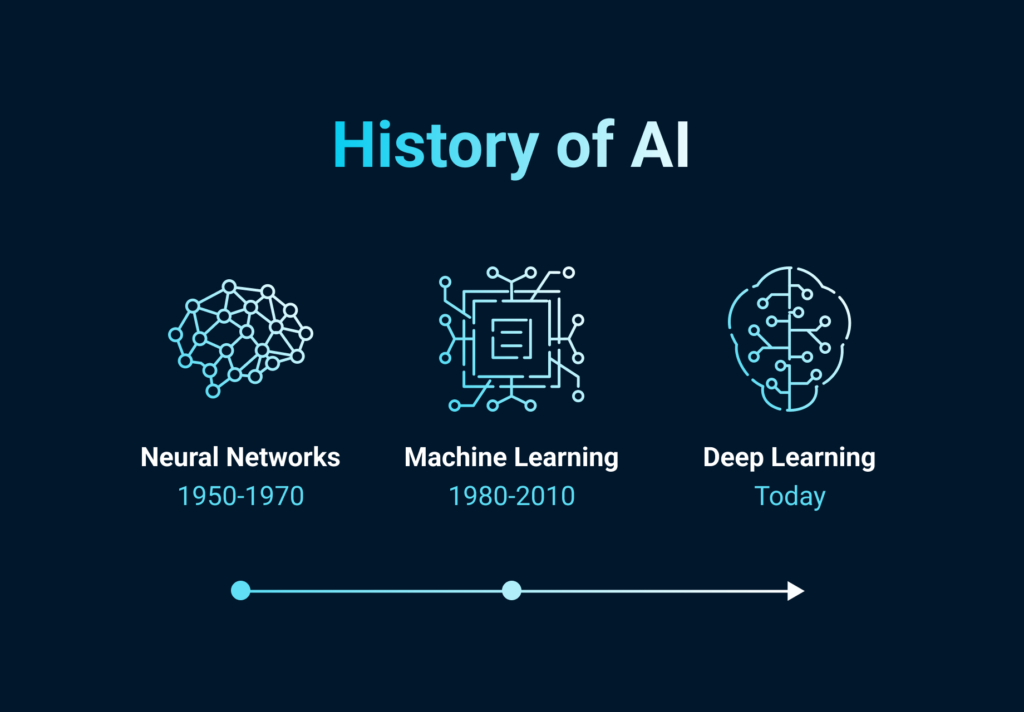
The 1990s saw neural networks bounce back, thanks to better hardware and tweaks to backpropagation. This algorithm, from the 1980s, trains networks by adjusting connections based on errors—like fine-tuning a bike until it rides smooth. Statistical methods started beating pure symbols, as data became king.
Judea Pearl’s work on probabilistic reasoning added tools to handle uncertainty. By the early 2000s, machine learning grew as a branch of AI, focusing on patterns in data rather than hard rules. This renaissance marked a key turn in the history of artificial intelligence.
Major Milestones in Problem Solving
AI hit big in games, proving its chops beyond labs. IBM’s Deep Blue beat chess champ Garry Kasparov in 1997 after years of work. It searched millions of moves per second, blending brute force with strategy.
Later, in 2011, IBM’s Watson crushed Jeopardy! champs. Watson parsed natural language and pulled answers from vast info, showing AI could handle fuzzy questions. These wins built trust and funding, pushing the AI timeline forward.
The Data Explosion and GPU Acceleration
The internet flooded the world with data by the 2000s—think emails, photos, and web pages piling up as Big Data. This treasure trove fed machine learning models hungry for examples.
Graphics Processing Units, or GPUs, sped things up too. Originally for video games, they crunched parallel math fast, training networks in days instead of months. Nvidia’s tech became a staple, fueling deeper AI progress toward 2012.
The Deep Learning Revolution and AI Ubiquity (2012–2022)
ImageNet Moment and the Deep Learning Breakthrough
Everything changed in 2012 with the ImageNet competition. AlexNet, a deep convolutional neural network by Alex Krizhevsky and team, slashed error rates in spotting images from 25% to 15%. This deep learning win proved layered networks could learn features like edges and shapes on their own.
The buzz spread quick. Researchers piled on, refining CNNs for vision tasks. In the neural networks history, this was the spark that lit the fire for widespread use in apps like photo tagging and self-driving cars.
Triumph in Complex Games and Natural Language Processing (NLP)
AI conquered tough games next. DeepMind’s AlphaGo beat Go master Lee Sedol in 2016, using reinforcement learning to intuit moves in a game with more possibilities than atoms in the universe. It learned by playing itself millions of times.
In NLP, transformers changed the game from 2017. Models like BERT and early GPT versions understood context in text, powering chatbots and translations. For a deep dive on GPT models, check how they build on this base. These strides made AI feel more human.
AI Integration into Everyday Life
By the late 2010s, AI slipped into daily routines. Siri and Alexa listened and responded in 2011, but by 2020, they got smarter with context. Netflix’s recommendations kept you hooked using AI picks.
Autonomous cars from Tesla rolled out prototypes, sensing roads with cameras. Businesses grabbed cloud AI tools from Google and AWS to add smarts without building from scratch. This era made the AI evolution real for everyone.
The Generative Era and Future Trajectories (2023–2026)
Large Language Models (LLMs) and Multimodality
From 2023, generative AI exploded with LLMs like GPT-4 and Claude. These models spit out essays, code, and images from prompts, blending text and visuals in multimodal ways. DALL-E and Stable Diffusion turned words into art, blurring lines between human and machine creativity.
By mid-2024, systems handled audio too, like transcribing speeches with tone. In March 2026, we’re seeing LLMs in schools and offices, aiding writing and design. This phase caps the AI timeline with tools that create, not just analyze.
Navigating Ethical Frameworks and Regulation
Advanced AI raised red flags on bias and safety. Debates heated up over deepfakes and job loss, pushing rules like the EU AI Act in 2024, which sorts tech by risk levels. US bills followed, aiming to curb misuse.
Experts stress fair training data to cut prejudice. By 2026, projections show the generative AI market hitting $100 billion, per McKinsey stats. Balancing innovation and ethics becomes key in this history of artificial intelligence.
The Road to AGI (Artificial General Intelligence)
Researchers chase AGI—AI that thinks across tasks like humans. Trends in 2025 focus on better reasoning and memory, with models like o1 from OpenAI planning steps like a strategist. We’re not there yet, but by 2026, hybrid systems might handle work, play, and learning all at once.
Think of it as evolving from a specialist to a jack-of-all-trades. Labs pour billions in, eyeing breakthroughs in energy-efficient chips. This path hints at profound shifts ahead.
Conclusion: Key Takeaways from AI’s Historical Arc
The history of artificial intelligence shows a rollercoaster of hype, freezes, and leaps. From Turing’s test to generative wonders, it’s all about better tech, more data, and clever code driving change. Understanding this arc helps us guide AI’s role in our lives.
Here are the big moments in bullet points:
- 1950s Spark: Turing Test and Dartmouth birth AI dreams.
- 1970s Chill: First Winter hits from overpromises and weak hardware.
- 1980s Pivot: Expert systems prove real-world wins.
- 1990s Reboot: Neural nets and milestones like Deep Blue build momentum.
- 2010s Boom: Deep learning and everyday tools make AI stick.
- 2020s Create: LLMs and ethics shape the path to AGI by 2026.
As we hit 2026, AI touches every corner—stay informed to use it wisely. What part of this timeline excites you most? Dive deeper and shape the future.

About the Author:
Shankar Sharma is a technology blogger focused on artificial intelligence and emerging digital tools. Through AI These Days, he shares in-depth guides, tool reviews, and practical insights to help users stay updated with the fast-changing AI landscape.